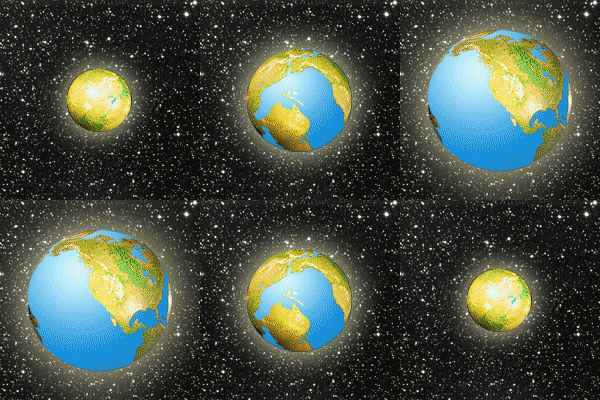
Results of a long discussion with a bunch of geologists. That's not to say that they agree with me -- far from it -- they stated in no certain terms that I am a "jackass." But as is usually the case when dealing with academics, I learn the most valuable information
in spite of rather than
because of its source.
There are three lines of evidence to support the idea that the Earth is expanding, with the oceans constituting the increased surface area: They are geologic, biological, and historical.
The geologic ones are the most compelling, so I'll begin there:
1) As is well-known, the continents adjacent to the Atlantic fit together, that the Midatlantic ridge traces their breaking point, new crust is continually being created at the Midatlantic ridge, and the oceanic crust gets progressively older the further one gets from the Ridge. To verify that, take a look at the image to the right, which shows sea crust ages with red youngest and blue oldest.

2) What's not so commonly known as that the Americas fit with Australia and the Asian trench system as well.
a) Look at Australia and South America. The nub on the Eastern cost of Australia fits into the indentation in South America. Also, look at the East Pacific rise. Although turned slightly clockwise and elongated slightly, it's a perfect fit for Western coast of South America. That turning and elongation is reasonably explained by the existence of another ridge, running from the East Pacific rise to the Chilean coast, and itself producing new crust.
b) Look at the trench immediately off of Kamchatka, headed south to the Mariana trench. Notice that if you slide that trench along the curve of the Aleutian trench, it would be a perfect fit for the Western Coast of North America.
3) So the continents fit together like puzzle pieces on
both ends. Is it proof that they were once connected? No. But the evidence that they fit on one end is just as good as the evidence that they fit on both ends, because it is based on identical facts. It seems to me, then, more reasonable to conclude that they were one once linked on both ends than to conclude they were once linked on only one.
4) Also interestingly, the sea crust is
substantially younger than the continental crust. Like ... the oldest sea crust dates to approximately 250M years, while the continental crust dates to approximately 4B years. While those dates are based on questionable methods and shouldn't be taken as gospel, they do provide stong evidence that the Atlantic and Pacific (at least the Pacific East of the trenches) formed at the same time. Standard theory, of course, has it that all the continents were bound in Pangaea, and then split, floating their way back into the Pacific, which is (presumably) growing ever smaller. In that scenario, of course, we would expect the Pacific to be older than the Atlantic -- after all, the Pacific was already there when Pangaea broke up. But interestingly, it's not. Both oceans are the same age. And much younger than the continents.

5) The trenches in the Pacific experience extremely frequent earthquakes. There's really no question about that. But a little known fact about those earthquakes is that the earthquakes less than 300km from the surface at
tensional, rather than
compressional earthquakes. What that means, in simple terms, is that the wave characteristics of the earthquake indicate that it was caused by crust
pulling apart, rather than being pushed together. Standard theory explains this as being a result of the downward moving, subducting slab being pulled away from the crust above it. The "Benioff zones" are also used to bolster this conclusion. As in the earthquake map above, earthquakes occur at progressively greater depth as one moves away from the center of the Pacific. This is seen as consistent with increasing depth of the slab subducting under the Asian plates.

There's a problem with that interpretation, however. Specifically: the "subduction" zones don't look like one rock going under another. The trenches, for example, are enormously deep, and steep --
usually less than 5 degrees from vertical. descending quite quickly. (
Don't be fooled like I was by pictures that show them to be super-steep -- the vertical scale is consistently exaggerated, even on 3d images without a scale). They are also generally quite wide -- often approximately 50km wide. Is that what we'd expect if one giant piece of rock was being pushed under another? No way. First of all, we would expect compressional, rather than tensional earthquakes, as the subducting slab pushed against the continental slab. We have the opposite. We would expect a moderate slope toward the subduction zone that showed us the direction of motion of the slab. Instead we have a flat seafloor, followed by an enormous drop
in a nearly vertical direction. Further, while we have direct physical evidence of new crust being formed at the ridges, we do not have direct physical evidence of old crust slipping under the other crust at the subduction zone. Finally, if one plate is slipping another another, we would expect an immediate rise in the crust that's on top -- but we don't have it. We have a volcanic zone some distance beyond the trench, but no slow rise right there to account for the "buried" ocean crust.

It simply does not look like subduction is happening.
But what if those trenches are not caused by subduction, but by stretching? What if the giant, steep trench is caused by the two plates
pulling apart rather than being forced together? Well, we'd expect it to be steep (which it is) look the slope of a glacier when an iceberg breaks off. We'd expect it to be wide (which it is), rather than narrow, as it was continually being pulled apart. We'd expect a lot of earthquakes (which there are) from the pulling motion. We'd expect volcanos on the continental side, as the pulling motion "loosened" crust further toward the continent, creating passageways for lava from the mantle to reach the surface. Finally, we'd expect the earthquakes to get deeper and deeper as one approaches the continent (Benioff zones), as earthquakes only occur in brittle Earth, and the mantle is (except in its uppermost regions) plastic and not given to Earthquakes, and continental crust is much, much thicker than oceanic crust, allowing Earthquakes to occur at much deeper levels. Finally, we would expect the earthquakes (at least in the crust) to be tensional, rather than compressional. Which they are.

For icing, add the fact that the trenches on the Asian side of the Pacific fit the coast of North America perfectly.
Strong evidence, it seems to me, that the trenches are caused by
tearing, rather than
subduction.6) Expansion without subduction. One more important point in the realm of geology. An oceanic ridge surrounds the entire continent of Antarctica. The necessary implication is that there is expansion southward. In order to absorb that new crust (and keep the size of the Earth static), there must be a subduction zone going East to West around the Earth. But there is no such beast.

So enough geology. There's also evidence in biology.
1) This map shows the present-day distribution of marsupials. Interestingly, they're found in Australia and the Americas. Now don't get me wrong -- fossils of marsupials have been found on all seven continents (including Antarctica). But the fact that marsupials survived to a much later date in the Americas and Australia supports the idea that the continents were linked, such that Australia was ecologically and biologically linked with South America -- more linked, in fact, than to the ecosystems in between.
2) Giant animals in the past:

The fossil record is full of animals that could not survive in today's gravity. Arthropods bigger than humans. 3-ft long dragonflies. 2M millipedes. Giant claw reveals the largest ever arthropod" (2007), Biology Letters. And let's not forget the dinosaurs -- 350lb flying creatures, enormous saurapods, etc. No way in the world they could make it in today's world. Yet somehow, they used to. How? Maybe reduced gravity on a small world?
Finally, some historical references:
Plato wrote in the Timaeus:
"For these histories tell of a mighty power which unprovoked made an expedition
against the whole of Europe and Asia, and to which your city put an end.
This power came forth out of the Atlantic Ocean,
for in those days the Atlantic was navigable; and there was an island situated in front of the
straits which are by you called the Pillars of Heracles; the island was
larger than Libya and Asia put together, and was the way to other islands,
and from these you might pass to the whole of the opposite continent which
surrounded the true ocean; for this sea which is within the Straits of
Heracles is only a harbour, having a narrow entrance, but that other is
a real sea, and the surrounding land may be most truly called a boundless
continent."
What a strange lie. That is, if it is a lie.
But let's not forget old Genesis.
Gen 2:5: "For the LORD God had not caused it to rain upon the earth, and there was not a man to till the ground. But there went up a mist from the earth, and watered the whole face of the ground."
Gen 6:11: In the six hundredth year of Noah's life, in the second month, the seventeenth day of the month, the same day were all the fountains of the great deep broken up.
Gen 10:25: And unto Eber were born two sons: the name of one was Peleg; for in his days was the earth divided.
Also strange historical references. That is, unless something crazy and cataclysmic happened to the Earth's geology, causing massive changes in continental configuration.